

TL;DR
- Print longevity depends on materials and light exposure, not just “years to fade” claims
- Museums measure damage using cumulative light exposure (lux hours)
- Typical display lighting is kept around 50–100 lux for prints
- Independent testing shows many giclee prints can last 100+ years under proper conditions
- Dark storage can extend print life significantly beyond display life
If you have ever seen a claim like “lasts 100 to 200 years,” you are not alone. Longevity claims are everywhere in fine art printing, especially when it comes to giclee prints.
But those numbers do not tell the full story.
Real print longevity depends on more than just ink and paper. It depends on how the print is displayed, how much light it receives, and how it is stored over time.
If you are new to the process, it helps to first understand what giclee printing actually is and why it is used for fine art reproduction.
Why Longevity Claims Can Be Misleading
Most permanence ratings come from accelerated aging tests performed under controlled conditions. These tests are useful, but they rely on assumptions that rarely match real-world display environments.
A print in a bright room will age differently than one in a controlled gallery, and both will age differently than one stored in archival conditions.
That means longevity is not just about materials. It is about context.
How Museums Measure Print Longevity
One of the most important concepts in conservation is that light damage is cumulative and irreversible.
Instead of only measuring brightness, museums track lux hours, which combine:
- Light intensity (lux)
- Total exposure time (hours)
This provides a more accurate understanding of how much damage an artwork receives over time.
For prints and photographs, museums typically keep lighting levels around 50 to 100 lux and limit ultraviolet exposure as much as possible.
What Industry Testing Actually Shows
Independent testing by Wilhelm Imaging Research, one of the most widely referenced authorities on print permanence, provides real-world context for these longevity claims.
Using Epson SureColor P7570 and P9570 printers with UltraChrome PRO pigment inks, testing shows that many fine art papers and canvases can achieve:
- Over 100 years of display life under typical framed conditions
- Significantly longer lifespan when protected with UV-filtering glazing
- Dark storage life exceeding 300 years in controlled environments
Some materials tested exceed 400 years under certain conditions, although these estimates are based on controlled testing and assume moderate indoor lighting over time.
These tests are typically extrapolated from accelerated light exposure to represent conditions of roughly 450 lux for 12 hours per day, which is significantly brighter than most home display environments.
This is important because it reinforces a key idea: longevity numbers are real, but they are always tied to specific conditions.
Display vs. Storage Life
A print can have two very different lifespans depending on how it is handled.
Display Life
When a print is on the wall, it is exposed to light, temperature changes, and environmental conditions. Over time, this leads to fading or color shift.
Dark Storage Life
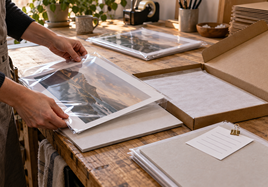
When a print is stored in archival conditions away from light, deterioration slows significantly. Proper storage can extend the life of a print well beyond its display lifespan.
This is standard practice in museums and among serious collectors.
Materials Matter More Than Marketing
Pigment Inks
Giclee printing uses pigment-based inks, which are far more stable than dye-based inks. This is one of the main reasons artists choose fine art giclee printing for their work.
Archival Papers
Paper choice is just as important. Cotton rag and high-quality alpha-cellulose papers offer better long-term stability.
If you are comparing options, our guide on how to choose fine art paper breaks down the differences between surfaces and materials.
In conservation environments, materials are often expected to meet standards such as:
- ISO 18902 for material safety in storage and enclosures
- ISO 18920 for recommended storage conditions
What Are OBAs and Why Do They Matter?
Optical Brightening Agents, or OBAs, are additives used to make paper appear brighter and whiter.
They work by absorbing ultraviolet light and re-emitting it as blue light, which enhances perceived brightness.
Over time, OBAs can diminish with light exposure. As they fade, the paper may appear slightly warmer, which can subtly affect how colors are perceived.
Why “Years to Fade” Is Not the Full Picture
Longevity ratings are often based on controlled testing, but real-world conditions vary.
Even in the same testing data, results change depending on whether a print is framed, protected from UV, or left exposed to open air.
This is why conservation professionals focus less on a single number and more on how materials behave under real conditions.
How to Make Your Prints Last Longer
For Display
- Avoid direct sunlight
- Use UV-protective glazing when framing
- Keep lighting moderate
- Rotate important pieces over time
For Storage
- Use archival sleeves and storage materials
- Keep prints in a cool, dry, dark environment
- Avoid basements, attics, and garages
What This Means for Your Prints
A print’s lifespan depends on three core factors:
- Materials
- Environment
- Exposure
Choosing the right materials from the start, especially when ordering giclee fine art prints, gives your work the best chance to hold up over time.
The Stackhouse Approach
At The Stackhouse, we use Epson SureColor P7570 and P9570 printers with UltraChrome PRO pigment inks, the same platform used in independent permanence testing.
Combined with archival paper options and controlled color workflows, this allows us to produce prints that are designed for long-term performance, not just short-term appearance.
Final Thoughts
Every print has a lifespan, but the goal is to extend that lifespan as much as possible in real-world conditions.
When you understand how light, materials, and storage affect your work, you can make better decisions that protect your prints for years to come.
Ready to print your work? Order your giclee prints and choose the right paper for your next project.
Related Reading