

A rolled art print should be opened slowly and given time to relax. Don't fight the curl with heat, water, sprays, a hard reverse roll, or heavy pressure on the image. Those shortcuts can turn a normal shipping curl into a crease, scuff, or surface problem.
Here is the safe plan: open the package on a clean table, hold the sheet by the edges, support it from below, and let it rest in a cool, dry room. Stackhouse normally rolls loose prints larger than 12 x 16 inches for shipping, as explained in the shipping and production guide. A gentle curve after opening can be normal.
Let a Rolled Art Print Relax First
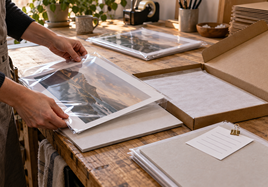
Remove the print from the tube or outer package without pulling hard on one corner. Keep the printed side from scraping against the tube edge. If the sheet is wrapped in a clean protective layer, leave that layer in place while you move it to the table.
Set the print down with the curve it already has. Don't snap it flat. Paper holds the shape it had during shipping, and it often needs time to loosen on its own. A larger or heavier sheet may need more time than a small one.
Set Up a Clean, Flat Work Area
Use a smooth, dry table that's larger than the print. Clear away drinks, food, tape, knives, rulers, frames, and anything dusty. Wash and dry your hands before touching the package. Cotton gloves can help with a large print or a matte surface that marks easily.
The full print care and handling guide recommends holding unframed prints by the edges and supporting larger sheets from underneath. That matters while the paper is still curled because one loose corner can swing into the table or bend under its own weight.
Unroll Without Touching the Image
Move slowly from one end of the sheet to the other. Keep one hand under the paper while the other guides the protective layer. Touch the edges, not the printed area. If the print starts to spring back, stop and let it keep its curve instead of pressing harder.
Look at the corners and surface as the sheet opens. A soft curl is different from a crease, dent, torn edge, ink rub, or crushed corner. If you see shipping damage, keep the tube and packing materials and take clear photos before doing anything else.
Do Not Force the Print Flat
Don't place books, boards, frame glass, or boxes directly on the image. Heavy pressure can press grit into the surface, leave a mark, or create a new bend. Don't reverse-roll the sheet tightly. Rolling against the curve can crack a coating or make a sharp crease near the edge.
Give the print room to relax without turning the process into a strength test. If it is almost flat, keep it protected on the clean surface and check it later. If the curl stays strong, ask Stackhouse or a trusted framer before adding pressure or trying another method.
Can You Reverse-Roll a Print?
Sometimes, but keep it gentle. First let an undamaged print relax on its own. If a soft curl remains, leave the print inside its clean protective paper and roll it loosely in the opposite direction around a clean, wide tube. Keep the protective sheet between the printed surface and the tube. Do not tape the print or pull the roll tight.
Unroll it and check the sheet instead of forcing it to stay rolled. Stop if the paper resists, buckles, creases, makes a cracking sound, or shows any change in the image surface. Skip reverse rolling if the print arrived wet, creased, crushed, or rubbed. Ask Stackhouse or a trusted framer if you are unsure.
Keep Heat, Water, and Sprays Away
An iron, hair dryer, steamer, humid bathroom, damp cloth, or spray bottle can damage the print. Heat may change the coating or paper. Moisture can cause waves, stains, color movement, or fibers that dry in a new shape.
The same rule applies to cleaners. Don't use glass cleaner, household spray, or water on the printed surface. If the print has a fingerprint, dust, or another mark, contact Stackhouse before rubbing it.
Move It to Safe Flat Storage
Once the sheet has relaxed, keep it in its protective packaging or an acid-free sleeve. Store it flat in a cool, dry place. Keep it away from direct sunlight, heat vents, damp rooms, garages, and large temperature swings.
Nothing heavy should rest directly on the image area. Keep the storage surface smooth, and make sure the print is fully supported. If you have several prints, use clean separators so one surface doesn't rub against another.
Check It Before Framing
A print is ready for the next step when it can be handled without fighting a strong curve. Check the corners, edges, image surface, and paper before placing it in a mat or frame. Paper prints are best protected behind glass or acrylic, with a mat or spacer keeping the image from pressing against the glazing.
Don't let the frame become the tool that forces a badly curled or damaged sheet flat. If the paper won't sit safely, pause and ask a framer or Stackhouse for help.
Know When to Contact Stackhouse
Get help when the print arrived creased, crushed, torn, wet, rubbed, or badly dented. Also ask before trying a flattening method that uses pressure, moisture, heat, or a reverse roll. Include the order details plus clear photos of the print, tube, and outer packaging when shipping damage is involved.
A normal shipping curl and physical damage are not the same problem. Giving the paper time is reasonable. Trying to repair damage at home can make the cause harder to judge and the print harder to replace.
Final Takeaway
A rolled art print should relax slowly on a clean, flat surface. Hold the edges, support the sheet, keep the image protected, and avoid heat, water, sprays, tight reverse rolling, and direct weight. Store the relaxed print flat or move it into a proper mat and frame. If the curl stays strong or the print looks damaged, stop and ask for help.
FAQ
How long does a rolled art print take to flatten?
There is no safe fixed time for every paper and size. Open the package carefully, let the print relax on a clean flat surface, and give it more time if the paper still wants to curl.
Can I use books to flatten a rolled print?
Don't place books or other heavy objects directly on the image. Pressure can scuff the surface, crease the sheet, or press dirt into the print.
Can I reverse-roll an art print?
A loose reverse roll may help an undamaged print after it has rested. Keep clean protective paper over the image, roll slowly around a wide tube in the opposite direction of the curl, and stop if the paper resists. Never make a tight roll or tape the print.
Can I iron or mist a rolled art print?
No. Heat, steam, water, and sprays can damage the ink, paper, coating, or color. Contact Stackhouse if the print won't relax or arrived damaged.