

TL;DR
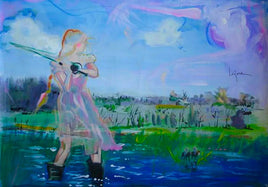
- Thomas Embley is an oil painter based in Utah, inspired by light, landscapes, and the humor of everyday life.
- After a previous career, he committed to making art full time and shifted to oils in 2020.
- His process starts with a clear concept, then moves from sketch to layered underpainting and refinement.
- High-quality prints help him expand his audience and drive art market sales.
Meet Thomas Embley
Artist, world traveler, former lawyer, and amateur historian, Thomas Embley has been called “a man of many talents,” but art has always been his driving passion. Drawing and painting since childhood, Thomas shifted from primarily acrylic and watercolor to oils in 2020 and immediately fell in love with the medium.
His original oil paintings are inspired by the beauty in the world, the humor in the mundane, the way light dances across objects, and landscapes of places that spark emotion and memory in the viewer.

If you’re preparing for art markets, the biggest decision is usually what to offer as originals versus reproductions. This guide helps you think through that: Guide: Choosing Product Type
The Interview
Can you tell us a bit about your journey as an artist? What sparked your interest in art?
“I’ve been drawing and painting since I was a kid, but my serious journey started when I decided to quit my previous career and focus on making artwork full-time. I’m beyond grateful that I am in a position where I can do what makes me happy. For me, it was primarily about accepting what I wanted to do with my life and completely disregarding what anyone else thought about it.”
Who are your biggest artistic influences, and how have they shaped your work?
“Definitely some local artists here in Utah, Glenn Dean and Bryan Mark Taylor. Plein air work has been really inspiring and has motivated me to get better at my landscapes.”

Could you describe your creative process? How do you typically begin a new piece?
“First, I’ll come up with an idea and visualize the finished product in my mind. Then I’ll sketch it out to establish composition and values, finally moving to the canvas where I work in layers, starting with the underpainting.”
What are some key tools or materials you use in your work and why are they important to you?
“I try not to add too many unnecessary extra materials to my work. A quality canvas, my paints, and brushes are really all I need, as each element serves its purpose and allows me to focus on what matters, making great art.”

What has been the most challenging phase in your career? How did you overcome it?
“Navigating the isolation of being an artist was really difficult at first. I overcame it by seeking out a community of like-minded artists and building relationships.”
Can you share a particularly memorable moment in your artistic career?
“The very first time I displayed my artwork in a public space I didn’t feel like anyone would appreciate my work. I was in absolute disbelief watching strangers marvel at my paintings and I even won an award that night.”

How do you balance the commercial aspects of being a professional artist with your creative process?
“I am very much still navigating that one. I paint because I love making art, not because I’m a salesman or a marketer. The benefit is I don’t lose focus of my goals. The drawback is I have to force myself to tackle the commercial angle.”
What advice would you give to artists trying to gain more exposure for their work?
“Apply to art markets. This gets your work in public and gets you in front of your prospective fans. There is no substitute for getting people to see your work in person and meeting your audience.”

How important is community to your work as an artist?
“Community is extremely important. Getting involved with community art associations has helped me establish relationships with other artists, set up public art installations, amplify local and new artists, and contribute to charitable organizations. I support Millcreek Art Council and Holladay Arts, as well as community foundations like Art Access Utah.”

If you could change one thing about the art industry, what would it be?
“There needs to be a renewed focus on teaching, appreciating, and making art. Creative expression is part of the basic human condition, and so often it is stifled, defunded, deprioritized, and now even outsourced to computer programs.”
How do you stay motivated and inspired to continue creating new work?
“Finding motivation is easy because I love it. If it wanes, I’m comfortable taking a few days off to rest. Inspiration can be another story. If I can’t think of my next painting, I’ll go on a hike in the Wasatch mountains or buy a new bottle of whiskey, then start a new painting. Putting paint to canvas can lead to inspiration.”

What upcoming projects are you excited about?
“I just finished the biggest painting I’ve ever made at 30x40 inches, and now I have to get a bigger canvas and one-up myself once again. I was also accepted into my favorite art show next year, so I’m producing a ton of work.”
Where do you see your artistic journey taking you in the next five years?
“I hope to keep improving my craft and get into more gallery shows so my work is on display year-round. I’d like to continue getting into larger and more prestigious art shows, perhaps even regional markets.”

Printing with The Stackhouse
How has working with The Stackhouse Printery impacted your work or opened new opportunities for you?
“Before I started working with The Stackhouse, I went through a number of disappointing printers. The Stackhouse has exactly the products I need and the quality to do justice to my artwork. Having high-quality prints available at art markets has greatly expanded my audience and represents a large proportion of my sales.”
What do you think about the role of technology, like high-quality art printing, in today’s art world?
“High-quality art printing democratizes art appreciation by allowing more people to access artwork without compromising the artist’s vision.”
If you’re preparing prints for markets, choosing the right size and border presentation can make your booth feel instantly more professional: Selecting Print Size and Border Options
Ready for museum-quality reproductions? Giclée Fine Art Prints