

TL;DR
- Mika Denny is a Southern California figurative artist focused on emotionally rich portrait work.
- Her drawings blend realism with expressive elements like color, line work, and decorative paper.
- She builds portraits through layered mark-making, from small studies to larger final works.
- Mika produces fine art giclée prints on Photo Rag with The Stackhouse for exhibitions and collectors.
Meet Mika Denny
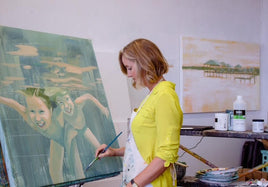
We had the pleasure of interviewing Mika Denny (pronounced Meeka), a Southern California-based figurative artist whose portraits capture emotion with striking light and shadow. After a successful career in graphic design, Mika explored painting, ceramics, and crafting before finding her true artistic calling in figurative drawing in 2018.
Her portraits blend realism with expressive depth, drawing viewers into the story behind each subject. Below, Mika shares her journey, inspirations, and creative process, plus how high-quality printing helps her make her work more accessible.

If you’re exploring prints for your own work, these guides help: Guide: Choosing Product Type and How to Choose the Right Paper and Canvas.
The Interview
Can you tell us a bit about your journey as an artist? What sparked your interest in art?
I was born and raised in Laguna Beach, California, a city vibrant with artistic energy. According to my mom, my love for art emerged early, she fondly remembers my obsession as a toddler with drawing teeny, tiny circles. Growing up with creative parents in a community teeming with artists, galleries, and annual art festivals was profoundly inspiring.
I was fortunate to receive a four-year scholarship from the Laguna Beach Festival of Arts to pursue a creative arts degree and earn a Bachelor of Arts in Graphic Design. I then enjoyed a decades-long career in graphic design while raising my family. However, after years of designing and creating for others, I felt the need to explore something more personal and deeply rooted in fine art.
In 2018, after experimenting with painting, ceramics, and crafting, I rediscovered my first love: figurative drawing. Returning to pencil work felt like coming home. Drawing people from all walks of life allows me to capture the shared emotions and experiences that connect us.
Who are your biggest artistic influences, and how have they shaped your work?
Early on, I admired the works of Alphonse Mucha, Gustav Klimt, and Tamara de Lempicka. Their ability to merge portraiture with intricate, illustrative details captivated me. Mucha’s line work and ornamentation, Klimt’s patterns and symbolism, and Lempicka’s bold elegance left a lasting impression on me.
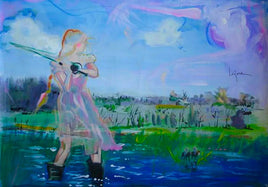
My charcoal portrait drawings lean toward realism, but I also experiment with unexpected additions of color, line work, and sometimes decorative papers. I weave these elements into my portrait work to enhance its visual impact.

Could you describe your creative process? How do you typically begin a new piece?
It always starts with the muse for me, finding that intriguing person, whether a hired life model or a stranger I approach in public. I take several photos from different angles and expressions to capture the essence of the subject.
Often, I begin with a smaller preliminary sketch to explore how shadows and light interact and establish the composition. I stay open to my instincts, deciding where to add color, decorative paper, or leave certain lines sketchy and loose.
Once I’m satisfied with the sketch and have developed the overall plan, I move on to creating a larger portrait. I love watching the work evolve on paper, adding layer after layer, shifting between tight pencil work and loose pastel brushstrokes.
What are some key tools or materials you use in your work and why are they important to you?
Holding a pencil in my hand is a core memory for me. After 50-plus years, it is and will always be my favorite way of making art. Using pencils allows me to capture fine details and subtle nuances.
With the addition of PanPastel, I can contrast precise lines with softer, more gestural marks, creating a balance between detailed drawing and a painting-like delicacy. This mix combines structure with spontaneity, which I find very appealing.

What upcoming projects are you excited about?
I can't wait to get back to the drawing board. I’m working on more portraits for lots of exhibitions this year, and I’m also applying for an exhibition opportunity that would fill up an entire summer. Fingers crossed I jury in.
Can you share a particularly memorable moment in your artistic career?
About four years ago, I created a bucket list to guide my artistic journey. In the past two years, I’ve checked off some exciting goals that have become unforgettable moments. I was published in two national art magazines, including Artists Magazine as a finalist in The Best of Drawing: Strokes of Genius 15 issue, and in American Art Collector in 2024 for an exhibition at the Historic Salmagundi Art Club in New York City.
I also had my first solo show, “People Watching,” which led to my work being acquired by the Hilbert Museum of California Art. I invited Founder Mark Hilbert and Director Mary Platt for a private tour of my show, and they subsequently purchased two pieces for their permanent collection.

Where do you see your artistic journey taking you in the next five years?
I hope to exhibit my work internationally, sharing my art with a broader audience and gaining new experiences that will push my creative boundaries. I also plan to continue working through the goals on my bucket list. Ultimately, I want to keep evolving, stay true to my vision, and connect with people who resonate with my art.
How do you balance the commercial aspects of being a professional artist with your creative process?
Honestly, sometimes I wish I didn’t have to deal with promoting my work at all. I’d rather just draw all day in my studio, listening to tunes or podcasts. Thankfully, my background as a graphic designer and creative director made building my website and social media content manageable.
But it’s the smaller tasks, shipping, entering exhibitions, and staying on top of emails, that take time. I try to stay organized and set aside space for both the business side and the creative work, but it’s always a balancing act.

What advice would you give to artists trying to gain more exposure for their work?
Find your tribe. Connecting with other artists can be incredibly beneficial, whether online or in person. Start by following artists you admire on social media, attending workshops, and learning from their experiences.
I joined an online Facebook community a few years ago where I shared my work and received encouragement. That led to unexpected opportunities, like teaching lessons for an online school and creating my own courses. Joining a local art club is also a great way to build connections and grow through classes, exhibitions, and events.
Explore multiple ways for your work to be seen, both in person and online. You never know where it might lead.
If you could change one thing about the art industry, what would it be?
I’d love to see greater equality for women. While there have been strides, women artists are still often underrepresented and undervalued compared to their male counterparts. Creating more opportunities for women to be showcased and celebrated on equal footing would make the art world more vibrant and equitable.

How do you stay motivated and inspired to continue creating new work?
I’m continuing to look for ways to evolve my work and add color and aspects of contemporary realism to my portraits. I’m also developing a series inspired by “Muse Encounters,” everyday people I meet in public places.
Approaching strangers and asking to take their photo as a reference is scary yet thrilling, especially when they say yes.
Printing with The Stackhouse
How has working with The Stackhouse Printery impacted your work or opened new opportunities for you?
When several people asked if I sold prints of my work, I realized it was time to figure it out. After research, I found The Stackhouse Printery. Even with the distance, me in California and the team in Florida, I decided to give them a try.
I tested different papers and fell in love with giclée prints on Photo Rag. The quality has been outstanding, and the packaging is always perfect, especially the individual bagging and extra space around the image for my signature and edition numbering. I’ve never had to return a print because the color reproduction is always spot on.
I created an online print shop for clients to order from, and I sold many prints at my solo show. I recommend The Stackhouse often and have shared their name with other artists.
What do you think about the role of technology, like high-quality art printing, in today’s art world?
Offering high-quality prints makes my work accessible to more people who may not be able to afford an original. I’m grateful to have partnered with The Stackhouse, whose support helped my business take the next step.
Want to make prints that feel true to your originals? Explore Giclée Fine Art Prints and review Submit Artwork Printing Guide plus Color Correction Explained before you upload.
Get Printed Like Mika
If you’re ready to sell editions, prep for a show, or offer prints online, we can help you create museum-quality reproductions with consistent color and clean presentation.
Find Mika Denny

Related Reading
- What Is Giclée Printing?
- How to Choose the Right Paper and Canvas
- Selecting Print Size and Border Options