

TL;DR
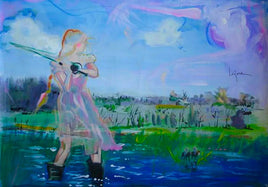
- Felix Burgos is a New York-based artist known for hard-edge acrylic paintings with occasional oil-rendered figures.
- His visual language is shaped by decades in advertising and graphic design, with bold color and structured composition.
- He starts with sketches, refines layouts in Photoshop, then builds crisp edges using tape and layered paint.
- Archival scanning and printing support limited edition sales and expand access beyond original paintings.
Meet Felix Burgos
Felix Burgos discovered his ability to draw early and was inspired by an uncle who painted seascapes. After attending Music and Art High School in Harlem, he went on to study advertising design at FIT.
Felix spent more than four decades as a graphic designer in advertising. That experience now strongly influences his painting style, especially his sense of structure and color. Advertising also pushed him back into painting as a way to relieve stress. His studio practice became an escape, and eventually a new direction.

The Interview
Can you tell us a bit about your journey as an artist? What sparked your interest in art?
“I discovered my ability to draw when I was about 7 years old. One of my uncles, Ray, was a painter. I was fascinated by his ability to paint that seascape with seagulls. I was hooked. I attended Music and Art H.S. in Harlem, quite the commute from Brooklyn, but I loved it there. From there I was accepted at FIT and majored in Advertising design.
I still loved fine art but didn’t want to be a starving artist. My painting style today has been greatly influenced by 40+ years as a graphic designer in advertising. Advertising was also the driving force behind my motivation to start painting again. It helped relieve the stress I felt working in that industry. My paintings became my escape.”
Who are your biggest artistic influences, and how have they shaped your work?
“I love Hockney’s sense of color and Kandinsky’s abstract shapes and how they play off of each other.”
Could you describe your creative process? How do you typically begin a new piece?
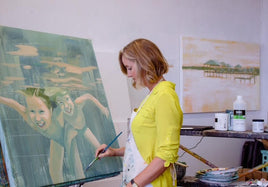
“I’ll usually start with a very rough sketch. I then work in Photoshop to refine the layout. I work in a hard-edge style and work mostly in acrylics. Any figures in my work are created in oil.”

What are some key tools or materials you use in your work and why are they important to you?
“I’ll sometimes work with linen canvas but mostly on cotton canvas. Oils, acrylics, and lots of tape. Acrylics dry quickly and are great for hard-edge painting for that reason. Oils are great for figures or any subject that may need blending since the dry time is much longer. It allows me to step away and revisit the subject. Sometimes you just need to walk away.”
What has been the most challenging phase in your career? How did you overcome it?
“The most challenging phase in any painter’s career is finding your voice. I struggled with this for several years. You need to find your own style and be able to replicate it no matter the subject. I want someone to walk into a room and be able to say, ‘That painting there was created by Felix Burgos.’”

Can you share a particularly memorable moment in your artistic career?
“I didn’t know if anyone would be interested in my style of painting, so I uploaded a few paintings to Saatchi Art. With so many artists and works on the site, I would have been happy with a few views. Within a few months I sold my first painting to a collector in Boston. Several months after that, I was featured in one of their publications and sold a few more. Today I’m no longer selling on Saatchi, but it was a great start.”
What advice would you give to artists trying to gain more exposure for their work?
“Try getting into local shows, even a show like The Other Art Fair. You’ll network with many young artists. But do not give your work away. It takes a great deal of time to create. Get paid for it.”

If you could change one thing about the art industry, what would it be?
“Most galleries are on a 50% commission. Ouch. Not sure how we can change that. Selling on your own is an option, but it’s challenging.”

What upcoming projects are you excited about?
“I recently showed at Art On Paper in New York. That was a great experience for me. My work may be shown at CONTEXT Art Miami this year. Hope that goes well.”

Printing with The Stackhouse
How has working with The Stackhouse Printery impacted your work or opened new opportunities for you?
“Love the quality of the work. And I see there are some packages I may try and take advantage of as I try and sell more on my own.”
What do you think about the role of technology, like high-quality art printing, in today’s art world?
“High-quality scanning and printing has given me a whole new source of revenue. Not everyone can purchase an original piece, so a limited edition archival print is a great option.”
If you’re offering editions, it helps to understand the terminology collectors expect: What Is Giclée Printing?
For limited editions, presentation matters. This guide breaks down sizing and borders: Selecting Print Size and Border Options
Ready to produce museum-quality reproductions? Giclée Fine Art Prints